Showing posts sorted by relevance for query libya. Sort by date Show all posts

Tuesday, March 29, 2011

In the press, Rafale operations over Libya

Libya strikes showcase French warplane

By Andrew Rettman
EUOBSERVER / BRUSSELS - Many commentators believe the Libya air strikes are a pre-election advert for President Nicolas Sarkozy. Some believe they are also an advert for France's badly-selling Rafale jet fighter.
Several EU diplomats and even one foreign minister speaking off the record in Brussels in the run-up to the Libya campaign pointed to next year's French presidential elections as a big reason for Sarkozy's enthusiasm to take on the Libyan dictator.

But looking in detail at French operations in Libya, military analysts have also said that France is using the war to promote its badly-selling €60-million-per-unit Rafale fighter.

Read the Full article here

France's floating frontline against Libya's Gaddafi

Sun Mar 27, 2011 12:41pm GMT
By Elizabeth Pineau
ABOARD AIRCRAFT CARRIER CHARLES DE GAULLE (Reuters) - Dressed in a khaki uniform and protective helmet, a French pilot emerges from the Rafale fighter jet that just landed on the deck of the Charles de Gaulle carrier, back from another mission over Libya.
A dozen mechanics scramble to assess the plane: the fuel specialists wear red, the maintenance crew green and the on-deck traffic controllers wear yellow, barking orders that have earned them the French nickname "yellow dogs".

Read the Full article here

Sunday, May 22, 2011

In the press, Latinaero articles about Rafale and AASM Engagement over Libya

Latinaero has released a preview of its first issue which should be available next June. It can be downloaded directly on their web site (or here as a backup). The first part of an article about the Rafale at war in Libya (written by defrense journalist Jean-Michel Guhl), can be read in this issue (mainly about AASM bombs)

Here are very interesting extracts about the AASM capabilities (for the record) :

[...] The greatest operational value of the AASM is that it is a true stand-off weapon, which means it can be fired safely from outside the range of existing
enemy short and medium range air defence systems, whether at high or low
altitude
. According to Lieutenant General Patrick Chareix, of the French Air Force
CDAOA staff, this fact was proven on several occasions during the initial phase of the interdiction campaign over Libya where the Rafales operated without the need of any dedicated SEAD asset —and
to the big surprise of the USAF theatre commander on one specific action against a Libyan SA-3 “Goa” SAM site
in March 2011!.

Its solid rocket propulsion system gives the AASM a range of over 50 km when fired from high altitude, and
over 15 km for low-altitude firing. In the latter case, the AASM can also climb over its release point to avoid difficult terrain, while providing a near vertical terminal trajectory for better final precision.

These characteristics are awsome, as most of the time, the AASM strikes come as a full surprise for an observer on the ground, for the simple reason that the launch aircraft is unseen and unheard… even more when the launch aircraft is a Rafale, thanks to its stealthy characteristics.

AASM launch domain ©Latinaero
Quite a surprising and positive point is the fact that the AASM can be fired off-axis in relation to the aircraft’s flight path, thus optimizing its extended range and enabling it to hit distant targets right behind the aircraft —something totally impossible for a conventional laser-guided bomb.
 From the operational standpoint, this enables the aircraft to immediately engage its target, without having to manoeuvre to place the launching aircraft in position, as would be required for other existing laser or GPS-guided tactical weapons.

A very valuable tactical advantage is also that the AASM allows a single aircraft to engage up to six targets simultaneously ! For example one Rafale fighter fitted with two triple underwing Rafaut hard-points —as was the case during “Opération Harmattan” over Libya— can loiter and attack successively or in a single action up to six targets of different nature located in opposing directions. For that, the Rafale pilot (or navigator in the two-seat models) can use target coordinates previously programmed on the ground during mission briefing, or even in flight at the last minute in the case of time-sensitive targets ! This in-flight reprogramming capability relies on new coordinates either sourced through the Rafale’s tactical data link terminal (NATO L-16) or obtained via the laser rangemeter of a Damoclès targeting pod.
[...]

So, Jean-Michel Guhl confirms, once and for all, in this article that the AASM can be launched at a target behind the aircraft, and so, apparently even at low altitude (see the AASM lauch domain drawing above). Moreover, the Rafale/AASM combo can perform a 180° off boresight attack in a multarget scenario which is quite amazing

Also worth reading, a handfull of  very instructive articles about the Rafale engagements over Libya :
Hammer does it again
French Air Force Rafales continue to hammer down Kadhafi’s forces piecemeal
French Rafales strike deep into Libya
Target Libya ! French fighters now leading the way

Eyecandy from the links above ;)

Saturday, March 19, 2011

Details on the Rafale mission over Libya


All in all, some 20 airplanes are conducting the first missions over libya


11h00 AM 4 Rafale C (Provence squadron) armed with mica missiles left the Saint Dizier Air base to enforce the No Flight Zone over Libya (UN resolution 1973)

11h10 AM  A patrol of 2 more Rafale B with a Reco-NG pod left the Dizier Air base for a recce mission over Libya.

02h30 PM 2 mirage 2000D (Ardennes squadron / Nancy Air Base) escorted by 2 mirage 2000-5 (Cigognes squadron / Dijon Air Base) as well as 2 Rafale with AASM bombs rejoin Libya for CAS operations

Other air assets taking part in this first day : 6 French Boeing C135 (Bretagne squadron) and 1 E-3F from Istres and Avor Air bases.

EA-18G Growler with their 2 ALQ-99 jaming pods ready  to take off
American EA-18G Growler have also been seen on an Italian Air base and will take part in the SEAD operations.


At 05h45PM, the French MoD revealed that one of those fighters shot at a military Libyan vehicule.
Edit 1 : Qatar TV, Al Jazzeera is reporting that at least 4 Libyan tanks would have been detroyed by French fighters.
Edit 2 : It is now confirmed that a Rafale B from the Gascogne squadron has attaked a Libyan tank column with its AASM bombs detroying 4 of them.

French fighters engaged in the first stage of the operations over Libya


Source: Press conference of the French defense Ministry.
BBC News
Thanks to Tmor for additional info ;)

Monday, September 19, 2011

Libya, Rafale stats

Air&Cosmos published the Rafale stats after s 6 months of the Libyan campaign.
The French Air force Rafale were the very first fighter jets of the coalition to enter the Libyan air space on March 19th 2011 forcing the Gadhaffi forces attacking Benghazi to retreat.
8 Rafale B/C and 4 Mirage 2000 D/-5 took part in this first day operation destroying several tanks after a more than 2000 km flight from their home bases in France.
3 Days later, the Rafale M deployed onboard the CdG aircraft carrier were conducing their first recce mission over Libya.

All in all the Rafale M have remained 4 months in the theater logging 2000 flight hours in 1000 sorties (more than 7 sorties/day, 2 hours/sortie).

The Rafale B/C are still operating from the Sigonella Air Base, Scicilia, after 6 months of operation. They have logged 4000 flight hours in 900 sorties (more than 5 sorties/day, 4.4 hours/sortie)

it is worth noting than the Rafale M were able to performed 10% more sorties in a shorter amount of time (about 20% less days on site)  than the Rafale C due to the fact that they were operating closer to the war zone. Even more striking is the fact that the Rafale M logged twice less flight hours for about the same number of sorties for the same reason (Aircraft carrier very close to the Libyan coast).

The 1900 Rafale sorties represent more than 40% of the French Forces sorties and were splitted as followed :
  • offensive sorties (A2A and A2G) : 855 (45%)
  • Recce sorties : 855 (45%)
  • Budy-budy refueling (Rafale M only) : 190 (10%)
Also read :
Rafale goes to Libya... for war
Details on Rafale mission over Libya
First pictures of the Rafale engaged in Libya
First Rafale M mission over Libya
Video of the carrier operations onboard the CdG


Tuesday, May 31, 2011

Libya, Rafale in combat "for War Dummies"

This is a must read article written  by Giovanni de Briganti for Defense Aerospace
-Reproduced here for the record-


RAFALETOWN, Corsica --- French air force Rafale combat aircraft deployed here as part of the UN-sanctioned Libyan No-Fly Zone are for the first time making full use of the aircraft’s “omnirole” capabilities, which allow a single aircraft to carry out the full gamut of missions during a single sortie.

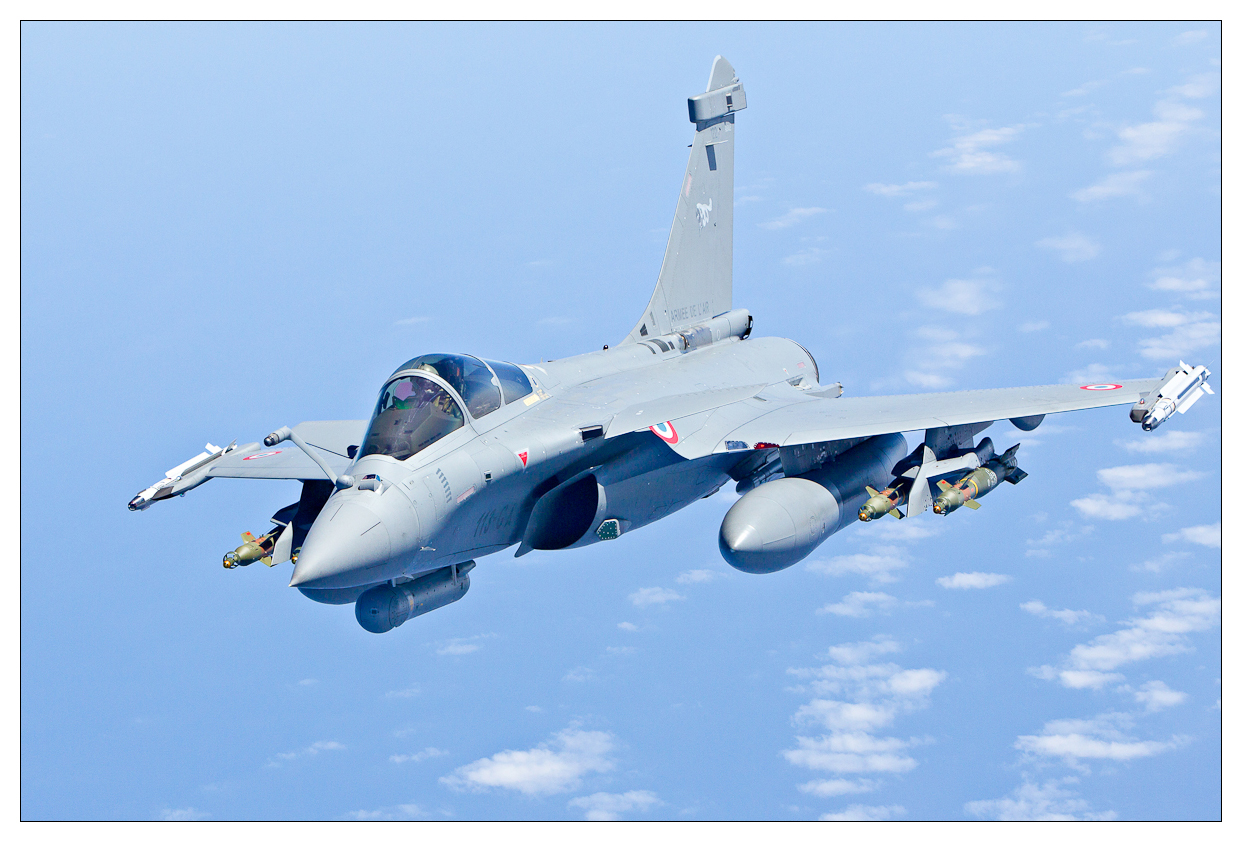
Pilots of the eight-ship Rafale detachment based here at Solenzara air base in Corsica, and provisionally dubbed “Rafaletown,” routinely take off with four MICA air-to-air missiles, three or six AASM Hammer precision-guided bombs, a Thales Damoclès laser targeting pod or a Reco NG reconnaissance pod and two drop tanks. They can be tasked or re-tasked in flight, and routinely are, to fly combat air patrol, precision strike or reconnaissance missions during the same six- or seven-hour sortie.

The AASM, or Armement Air-Sol Modulaire which carries the NATO designation SBU-38, is a precision-guided bomb developed by Sagem, and exists in two versions, with inertial/GPS or inertial/GPS/infrared imaging guidance. A laser-guided version is being developed.

“Rafale was involved in Libya from Day One, and we fly several missions during a single sortie,” says detachment commander Lt. Col. Pierre G., stressing that “Omnirole Rafale” is not simply an advertising slogan but an accurate description of the aircraft’s very real capabilities. “Over Libya, the Rafale flies all kinds of missions, carrying out strike assignments and reconnaissance with the Reco NG pod while conducting our main mission, which is combat air patrol. Pierre G. and other Rafale pilots spoke to reporters during a two-day tour organized by the French defense procurement agency, DGA, and the companies involved in the Rafale program. Because of operational security, pilots are referred to by their first name, or not identified at all.

Pilots say the Rafale’s networked sensors and systems make their job much easier and much more effective than with previous-generation fighters. “Two Rafales carry as much ordnance as two Mirage 2000-5 and four Mirage 2000D combined,” notes Pierre G., adding that their sensor capabilities “are much greater even than that.”

The Rafales work in a truly networked environment, and are fed targeting and other tactical data from a wide range of coalition sources through the Link 16 datalink. Incoming data is combined with that collected by the aircraft’s own sensors – Thales SPECTRA self-protection suite, OSF electro-optics, RBE-2 radar and even the infra-red guided version of MBDA’s MICA air-to-air missile which, as it scans continuously, can provide IR imagery to the central data processing system. “MICA is not just a missile, it’s an extra sensor as well,” says Pierre G., and its detection range is much longer than generally supposed.

Data from all on-board and off-board sensors are combined into a single tactical picture presented to the pilot on the cockpit’s central color display or, if desired, on one of the lateral displays. The pilot can select the data he wants, combine it with other data, and pass it on to his wingman or to other allied aircraft, ships or ground troops through the Link 16, without speaking a single word on the radio and, if not using the radar, without any transmission whatsoever. Link 16 can also be used to de-conflict assignments with other aircraft without using radios.

To illustrate the Rafale’s networking capabilities, one pilot described how the aircraft can receive target coordinates from an AWACS or another aircraft via Link 16. To accept the assignment, the pilot pushes a button, and the coordinates are automatically programmed into the AASM guided bombs, with no further action by the pilot who, once in range (up to 30 nautical miles), again pushes a single button to launch all three – or all six – AASMs to their individual targets. “We can fire the AASM against targets abeam or behind us, and can hit up to six in a single pass,” the pilot continues.

At Solenzara, reporters were shown video footage taken during a ground attack mission in Libya, in which three tanks said to be firing against civilian targets were destroyed by simultaneous direct hits by AASM.

To avoid overloading the pilot, the aircraft’s central computer prioritizes targets according to the threat they represent, and there are also modes to de-clutter the radar scope. The pilot can also decide to concentrate on a given aspect of the mission, and come back to others aspects.


 The flight line at Solenzara, showing a mix of single-seat and two-seat Rafale fighters. The base has been dubbed “Rafaletown” by French pilots. (French AF photo)


In a similar vein, the system analyzes and combines tactical information received from all sensors; for example, “if you receive a track from an AWACS, from your SPECTRA self-protection suite, or from your ‘wingee’ at the same time, the system will analyze all the inputs and show you only one track.”

Another pilot simply says that “the Rafale’s man-machine interface is so good it’s like ‘war for dummies’.”

Rafale pilots are also very complementary about their SPECTRA self-protection suite, which is of critical importance as France does not have any aircraft dedicated to the Suppression of Enemy Air Defenses (SEAD) missions. “SPECTRA allowed us to begin operations over Libya the very same day the political decision was taken, and to fly deep into Libyan territory without an escort,” says one pilot, adding that “the Americans also flew in, but only after they had fired 119 Tomahawks to take out Libyan air defenses.”

Rafale’s capabilities are changing the way the French air force operates. Previously, distinct pilot “communities” developed around each of the main missions flown – air defense, ground attack, strike, etc. – and lived more or less independently of each other. With the Rafale, however, this phenomenon is fading away since any unit, any aircraft and any pilot fly air-defense, strike or ground attack missions, as required. Specialization will disappear, several officers said, to be replaced by fewer but far more flexible aircraft and pilots.

“The idea that a single aircraft can be re-tasked in flight from reconnaissance to strike to interception during the same sortie is truly revolutionary, and we’re just now beginning to understand all that this implies,” says one officer.

This flexibility also translates into a major advantage for operational management, because any available Rafale can be tasked for any mission, without needing, as in the past, for a given aircraft-weapon combination to be available.

Missions from Solenzara are flown in two waves each day, one in daytime and the other at night, and the Rafales fire GPS-guided AASMs or laser-guided GBU-12 bombs on almost every mission. One Rafale also fired two Scalp cruise missiles, but so far the detachment has not fired the 30mm cannon as the minimum altitude mandated by the air staff is too high to use guns to good effect. Transit to Libya is flown at 50% power setting, which translates to Mach 0.9 cruise speed even with six AASM bombs and two large underwing drop tanks.

The detachment deployed at Solenzara comprises eight Rafales – a mix of single- and two-seaters – and three Mirage F-1CR dedicated reconnaissance aircraft, with 20 aircrew and supported by about 100 ground staff, 70% of them for Rafale, and 30 people to operate the intelligence detachment. Since Operation Harmattan (the French designation for enforcing the Libya No-Fly Zone) began on March 19, the detachment has flown 2,200 flight hours with over 1,500 in-flight refuellings, initially from their main operating base at Saint Dizier, in north-eastern France, and subsequently from Solenzara.

Aircraft turn-around, even with live weapons on board, requires only 90 minutes and an engine change requires one hour, although none have been changed during current operations.

Because of the time wasted flying from Solenzara to Libya, France is negotiating to transfer its Rafale detachment to Sigonella air base, in Sicily, which is much closer to the combat area. For the same reason, French air force Mirages have already been redeployed to Crete.

Maintenance requirements of the Rafale are about 25% lower than for the Mirage 2000, and there is no scheduled or preventive maintenance; maintenance depends only on the type of mission flown, and on the condition of components. Pilots at Solenzara say that, in just over two months of operations, no missions were aborted because of aircraft unavailability, and detachment commander Lt. Col. Pierre G. says that the availability rate is close to 100%.

Pilots interviewed for this story clearly love their aircraft. In addition to the electronics, they praise the comfort of their seat and its semi-reclined position, the effectiveness of the cockpit air conditioning (“I’ve never seen any condensation,” says one pilot) and the ease of adapting to the side-stick controller which, on Rafale, replaces the conventional central control stick. These are not necessarily major aspects, notes one pilot, “but after a few days of high-intensity combat, a Rafale pilot will be in much better shape than one flying another aircraft.”

Friday, April 15, 2011

Libya, AP report from the CdG


ABOARD THE CHARLES DE GAULLE (AP) — As French navy Rafale and Super Etendard fighter-bombers carrying laser-guided bombs catapulted Wednesday off the Charles de Gaulle aircraft carrier into a cloudless Mediterranean sky, officers onboard described the difficulties they face: Despite all the modern technology, troops loyal to Libyan leader Moammar Gadhafi are harder than ever to identify from the air.

Gadhafi's forces are now expertly camouflaging their units to conceal them from detection and attack from the air, the officers said.
"There is obviously a degree of savoir-faire on the part (of Gadhafi's forces) that we haven't seen before," said the commander of the carrier's air wing, who identified himself only as Herve.
He compared it to the performance of Serbian troops during NATO's airstrikes in Kosovo in 1999. The Serbs weathered NATO attacks and minimized their losses of tanks, armored personnel carriers, surface-to-air missiles and other vehicles through deft use of camouflage.

The Charles de Gaulle, a nuclear-powered carrier known in the French navy by its nickname "El Grande Charles," is cruising along the northern edge of the Gulf of Sirte, near Libyan territory. It leads a standard carrier task force of three frigates, a resupply oiler and a nuclear hunter-killer submarine.
From its decks, at least 20 sorties over Libya are launched each day.

The twin-engine Dassault Rafales flown Wednesday carried a combination of Mica air-to-air missiles, GBU-12 250-kilogram laser-guided bombs, GBU-58 125 kilogram bombs and laser pods designed to pinpoint targets for the bombs.

The Super Etandards, a modernized version of a single-engine strike jet originally introduced into the French navy's inventory in the 1960s, were armed with the laser-guided bombs.
The warplanes, divided into two five-jet flights, are charged with patrolling the battlefields and looking for targets of opportunity.

2 Rafale M with their Reco-NG pod ©Christophe Ena
 From the decks of the carrier, it can be hard to gauge the results of the action over Libya. NATO reported from its headquarters in Brussels that 12 tanks were destroyed near Zintan, and an ammunition storage site was destroyed near Sukhan, south of Sirte.

A Rafale M is dumpping fuel before landing ©Christophe Ena
NATO also said that 159 sorties had been flown Wednesday over Libya, 60 of them classified as strike sorties. But as officers on this ship know only too well, the pilots on strike sorties cannot always clearly identify targets; often they return without having dropped their bombs.

To observers on the ground the fighting appears to have changed little. But the naval task force's commander, Rear Adm. Philippe Coindreau, gave an optimistic report Wednesday. The back-and-forth stalemate of the first week of April had ended and opposition forces had seized the initiative, he said.
"There's been a reversal of that tendency; the oppositions forces have regained territory," he said in his headquarters on board the Charles de Gaulle. "Whether the air operation is more effective or not, I don't know."

He said, though, that coordination between NATO and the opposition in Benghazi has improved recently.
"Initially there was no coordination between the rebels and NATO, but nowadays NATO has more information through contacts with the opposition leadership in Benghazi," Coindreau said.
"I have a feeling that if the air campaign continues and if the political and diplomatic dialogue continues, then we can arrive at a cease-fire acceptable to all sides."

To journalists on the ground, the situation appears more nuanced. Weekend airstrikes around the city of Ajdabiya blunted an advance by forces loyal to Gadhafi. But it does not appear that the rebels have taken a significant amount of territory: The main front remains around the eastern city of Brega, and those rebel fighters who are in the west remain bottled up.
Coindreau acknowledged that it was still difficult for NATO to ascertain the exact balance of forces on the front lines between Brega and Ajdabiya, because Gadhafi's forces have started breaking their units into smaller, more maneuverable contingents and using civilian vehicles for transport and combat actions.
The Charles de Gaulle mounted the first reconnaissance flights over Libya on March 22. Attack missions followed almost immediately, and the ship has acted as the tip of the spear for the international aerial onslaught on Gadhafi's forces ever since.

Libya has two Soviet-built Foxtrot submarines that could threaten the Charles de Gaulle and the approximately 25 other NATO vessels patrolling the Libyan coastline.
"So far they have made no preparations to put to sea, so we have left them alone," Cmdr. Marc Gander said. "But we make sure to monitor them regularly just in case."

The NATO fleet has been joined by a smaller Italian carrier, the Garibaldi, but no U.S. Navy carriers have joined in the assault. An amphibious assault ship, the USS Kearsarge, which was in the region at the start of the U.S.-led operation on March 21, steamed away after Washington ended its combat role and turned the command of the operation over to NATO.
The Charles de Gaulle is the flagship of the French fleet and the only nuclear-powered carrier outside the United States.

It is also the only one outside the U.S. Navy to use the so-called CATOBAR (Catapult Assisted Take-Off But Arrested Recovery) system, whereby planes are launched by catapults and recovered by arrestor wires.
This allows fighter-bombers to carry much heavier loads than the alternative short takeoff systems used by most of the navies operating aircraft carriers.


Associated Press Writer Don Melvin in Brussels contributed to this report.

Tuesday, April 5, 2011

Reuters Special Report - How Libya is a showcase in the new arms race

A Rafale prepares to refuel on it way to libya
Mon Apr 4, 2011 4:11pm GMT
By Tim HepherPARIS (Reuters)

Extract from the article :
[...]

"MOST UNSEEMLY" In the immediate PR battle over Libya, analysts say the Rafale appears to be winning. Not only was it handed a front-page role on the first day of the conflict, but it also scored a symbolic victory by reaching Libya equipped for air-to-ground attack, something the Typhoon has so far only done in tests. The Typhoon is focussing instead on air-to-air warfare against an enemy whose air force has been more or less pinned to the ground by strikes on radars and air defences.

French officials dismiss any suggestion of deliberate showmanship in the deployment of Rafales in the opening hours of the conflict, saying their flexibility made them right for the task of destroying tanks that were closing on rebel positions in eastern Libya. But there is no doubt the lead taken by Sarkozy signals a more confident diplomatic posture that France hopes will benefit Rafale sales indirectly. Countries buying fighters must be ready to invest in a diplomatic relationship lasting 30 or 40 years, and competitors are bracing for an all-out French sales offensive once the conflict is over, or even before.

"Sarkozy has done a great job in getting the Rafale out there and hitting a convoy early on. He will go to export markets and say this is what our planes can do," said a defence executive from a rival arms producing nation. [ed. I sense some jealousy here ;)]

[...]

Read Full Article on Reuters.com

Friday, September 23, 2011

MMRCA, French general interview about the Indian contest

Nuclear capability, a key feature for India ?
The Times of India has published an interview of the French Air Force chief, General Palomeros. When asked about the Rafale Vs Eurofighter contest, the General provides some interesting points :

How does the Rafale match up with the Eurofighter Typhoon, the two finalists of the Indian MMRCA race?

"Rafale demonstrated its full capability during the Libya operations. We had 90 to 95% serviceability as well as reduced maintenance costs of both Rafales and Mirages. During the first three days, French air force was the only air force flying over Libya. We were able to enforce the no-fly zone as well as strike Gaddafi's forces with precision and minimum collateral damage. Rafale's digital reconnaissance pods provided a lot of intelligence in real-time for the strikes.

I do not want to compare fighters but Rafale was designed as a multi-role platform from the very beginning. It has been a real success, as shown in Afghanistan, Libya and elsewhere. I must also stress Rafale is nuclear-capable. It has real growth potential. France will be more than happy to develop it with India. It is, of course, up to India to now select the best platform it needs."

First, the General claims that the French Air Force was the only Air Force over Libya during the 3 first days of operations. That's very surprising. Officially the First French fighters were deployed on March 19th and other allied aircrafts were involved the next day. Therefore, if it's not a typo, that would mean that the French fighters were flying over Libya since March 17th for intelligence purpose.

It is worth noting that the General see the fact that the Rafale is a nuclear capable platform as a valuable argument for the MMRCA contest. Besides the ability to carry heavy nuclear missile and fuel tank, the nuclear mission also relies on the rafale capability to avoid Air defense systems and penetrates deep inside the Ennemy territory... a skill that could make the difference when India will make her final choice.

Also read : French Air Force General at Aero India

Monday, March 26, 2012

3 weeks in one post

We've been quite busy those days, but news about the Rafale kept on flowing. So, here we go :

  • Air International have published a nice article about operation Harmattan, and more specifically about the 12F's Rafale over Libya :
"During Harmattan, Flotille 12F demonstrated, in action , that Rafale is an agile, powerful, easy to fly fighter that offers excellent endurance and good-bring back capability" says Flotille 11F's commanding officer Captain Bertrand Lepoutre[...]"
  • Interviewed by Bloomberg, Charles Edelstenne, Dassault Aviation CEO, has shown very confident in the Indian deal :
“For 15 years, we’ve been saying the Rafale costs less than the Eurofighter,” Edelstenne said. “Now it’s the Indians who are saying it.”
Edelstenne said Dassault can easily boost production to two or three Rafales a month or more if needed
  • Air & Cosmos has published several articles entitled "How is Dassault preparing ?" We can learn that the integration of the GBU-49 is underway, requested by the Marine Nationale.
  • We have learnt that some Rafale over Libya were already equiped with the brand new DDM-NG.
  • Thales has manufactured the 10,000th module for the RBE-2 AA radar.
  • The UAE deal negotiation is accelerating, and Thales production plant is preparing for an evolution of Spectra. Qatar and Kuwait have renewed their interest in Rafale.
  • Libya may be the customer of the ex-UAE Mirage 2000-9, according to DefenceWeb. The information is "confirmed" by Jane's Defense Weekly.
  • Eric Trappier, interviewed by Les Echos, said that India wanted to sign the contract in 6 months. He also denies allegations charging France with illegal dumping, . More here.
  • EADS, Thales and Safran finance an Aerospace Training Center in Sao Jose dos Campos (21,000 sqm, €42millions, 5,800 students per year). This is a ToT agreement.
  • Saudi Arabia would have shown interest in the AASM for its Tornados. Meanwhile, France is still interested in the Brimstone. Aviation Week go as far as stating that the Brimestone could be integrated on Rafale before Typhoon.
  • Gerard Longuet, MoD, went to Saint Dizier to celebrate the first anniversary of the Harmattan Operation over Libya.
  • Dilma Roussef went to India so as to talk about trade and... Rafale.
  • Shiv Aroor, on his great blog Livefist, reveals the content of two letters : the one by the Member of Parliament M.V. Mysura Reddy who question the selection of Rafale, and the answer from the government ("I have asked the Ministry to examine all the points raised by you").
  • Finally, Dassault Aviation has launched a beautiful video : Rafale Before Flying

Saturday, July 23, 2011

Rafale and AASM-Hammer, a dynamic duo


20-07-2011 - As we have seen throughout recorded history, each new conflict seems to bring its own share of innovations. Recently, for example, the air strikes over Libya – Operation Harmattan for France, and Operation Unified Protector for NATO in the framework of the UN resolution 1973 – have spotlighted the unexpectedly powerful performance of a new French-made weapon, the AASM Hammer (Highly Agile Modular Munition Extended Range) air-to-ground modular weapon developed and produced by Sagem.


The AASM made a discreet debut in the spring of 2008, when the French air force deployed a 250-kg version in Afghanistan. Today, it is part of the standard combat suite carried by the Dassault Rafale F3 multirole fighter. In fact, it’s an integral part of the tactical air-to-ground arsenal deployed by both the French air force and naval air arm, and has also been chosen by the Royal Moroccan air force as part of their current program to modernize Mirage F1 fighters. The AASM Hammer is a medium-range guided weapon that can be used day or night and under all weather conditions – which is not the case of regular laser guided bombs, which have to be launched in the vicinity of air defense systems. Furthermore, these bombs’ guidance may be compromised, or even rendered ineffective by cloud cover or hard rain.

France has already ordered more than 1,500 AASMs in the 250-kg version. The AASM is a rocket propelled bomb with terminal guidance, capable of very high precision attacks on targets at a range of more than 60 km. In other words, it can be fired by Rafale or Mirage fighters from a comfortable standoff distance, outside the reach of enemy air defenses. The AASM stands out because it’s a modular weapon system, totally autonomous and jam-proof, flying resolutely towards its target once the coordinates have been manually loaded into the onboard computer by the pilot. The most advanced AASM models, like the Laser version now undergoing final tests, allow the modification of terminal guidance if needed to hit moving targets. In short, the AASM is a real “fire & forget” weapon. It could also be considered the equivalent of an air-to-surface missile, if only because its exceptional performance makes it the only weapon of its kind of the market for now.

Rafale C ready to take off from Solenzara AB with 4 AASM ©P. Wodka-Gallien
Furthermore, the AASM "Hammer" is a family of precision weapons, with guidance and propulsion kits fitted to standard bombs of different sizes: 125 kg, 250 kg, 500 kg and 1,000 kg – the latter dubbed the “bunker buster” because of its ability to penetrate several meters of reinforced concrete. The aft-mounted propulsion kit comprises a solid rocket motor and four winglets for flight control, deployed when the weapon is released.

The most commonly used version today is the SBU-38 (Smart Bomb Unit) AASM 250, with hybrid inertial/GPS guidance. There is also the SBU-54 version, combining an inertial guidance system (INS), GPS correction and terminal guidance via an infrared imager (IIR). The latest addition to the family is the SBU-64, which adds laser terminal guidance to the INS/GPS hybrid package, enabling the AASM to hit moving or even highly agile targets.

The AASM’s sophisticated terminal guidance means that this weapon features capabilities unmatched by a conventional laser guided bomb. In particular, the AASM offers a virtually vertical terminal trajectory, enabling it to attack, for example, a tank hidden behind a sand embankment or a concrete wall, or even a target in a narrow street or trench.

To date, the French air force has deployed about one hundred bombs in combat, all the SBU-38 INS/GPS version. This uses the basic guidance kit, with three inertial gyros whose directional pulses are managed by a Kalman filter and corrected in real time by satellite data from a military-standard GPS (Global Positioning System) receiver. The Kalman filter is actually a mathematical method, or set of algorithms used to improve accuracy. It is applied in the form of an infinite impulse response electronics filter that estimates the various states of a dynamic system, based on a series of incomplete or scrambled measurements. Sagem’s engineers paid particular attention to this issue, to ensure that the AASM flight path could be continuously corrected and recalculated according to a predicted path that would enable it to hit its target within several meters – after a flight of 60 kilometers or more, as was demonstrated in the Libyan theater of operations recently.

To further improve precision, Sagem has developed two new versions of the AASM, currently underoing final tests, that are no longer impacted by erroneous target coordinates: the SBU-54, which adds an infrared imaging mode, capable of recognizing a fixed target, the coordinates of which were first entered in its memory; and the SBU-64, using terminal guidance by acquisition of a laser spot, enabling it to destroy moving ground targets with a high degree of accuracy – to less than a meter in this case! A recent test demonstrated the effectiveness of this version against a target moving at 80 km/h.

Deploying both Mica air-to-air missiles and Hammer air-to-ground weapons, the Rafale fighters deployed in Libya have demonstrated unprecedented operational flexibility. The weapon system fulfills its assigned "swing role" capability, between air-to-air and air-to-ground missions. But in its configuration with four Mica and six Hammer missiles, the Rafale also provides real swing-role capability between different ground attack missions. For instance, a patrol in this configuration prepared for a Battlefield Air Interdiction (BAI) mission can change to a ground attack mission when already in flight, to perform dynamic targeting of very different types of targets, including air defense sites or armored vehicles arriving at the front lines, without being affected by different weather conditions.

  The most eloquent testimony undoubtedly comes from the French air force and navy pilots who deploy the SBU-38 daily, alongside their GBU-12 Paveway laser guided bomb, the standard 250-kg bomb used by NATO air forces.

According to Captain P, who is very satisfied with the performance of this new weapon, "In the Libyan theater of operations, as soon as we have the slightest suspicion of air defenses, which are always widely scattered in Libya, we remove the Paveway bombs and equip our Rafales with the AASM, because it allows us to effectively engage the enemy, away from their air defenses, especially the dangerous ’SAM rings’.

In TST (Time Sensitive Targeting) mode, the AASM’s range also allows us to hit a target without being detected from the ground, a possibility in asymmetrical combat. What’s more, a single Rafale can carry up to six AASMs. These are all significant advantages. Plus, since we can fire our weapons from further away than with the Paveway, and don’t need approach maneuvers, we save fuel – and in the combat environment, fuel is a key factor.

"The AASM is guided autonomously after being released, once the target coordinates have been obtained, whether they were uploaded to the system prior to the mission or in-flight. In TST mode, the target coordinates are generally provided by the Rafale’s optronics systems, either the front sector optronics (FSO) or the Damoclès pod. For the SBU-38 AASM, the Damoclès is considered an excellent coordinates extraction sensor. From the cockpit, we can also determine the terminal angle-of-attack in relation to the target. "Over the last twenty years, the nature of warfare has changed completely: the enemy is more diffuse and the risks of collateral damage a major concern. So we need new systems that reduce detection and allow us to engage several targets simultaneously. The AASM full meets these requirements for our operations in Libya, since it can be used not only for symmetrical combat, but also for asymmetrical combat as well as guerrilla operations”.

Saturday, September 3, 2011

Libya, AASM-IR is combat proven

Since august 18th and a picture released by the French Air Force, There were strong rumors about the first strikes using the AASM-IR in Libya. Indeed, the 2 AASM visible on the picture (see on the left) had the typical transparent window of the AASM-IR head.

It now has been confirmed by Air&Cosmos in its yesterday issue that the IR version of the AASM bomb has actually been fired in Libya for the first time, a few weeks only after it entered operational service on the Rafale.

The AASM-IR (SBU-64) is capable of 1m accuracy compared  to the 10m of the GPS/INS version (SBU-38).
A new anti-tank mode (new targeting algorithms to recognize vehicles) is also under development for this smart bomb.

Friday, August 5, 2011

Libya, The CdG takes some rest

After 9 months of almost non stop operations (4 months, Indian Ocean / 5 months, Libya) the Charles de Gaulle will stop, August 10th, for several weeks at the Toulon harbor for maintenance purposes.

The 6 Rafale M which were operating over Libya from the aircraft carrier will be replaced by 6 French Air Force Rafale B/C on the Sigonella Air Base, Sicily.

The CdG crew has demonstrated its outstanding endurance capacity since last November. Without any doubt, they deserve those few weeks of "vacations".

source : Reuters

Wednesday, December 29, 2010

No scalp for Libya ?


Rafale config for long range strike  
According to the Defense journalist Jean-Marc Tanguy, the Rafale sale to Libya woud have been jeopardized by the Refusal of the French government to include the sclalp-EG cruise missile in the bid.

The scalp-EG is a stealthy subsonic cruise missile using IIR terminal guidance with a range between 250 and 400 km. It is in Service in the French Air Force / Navy on the Mirage 2000D and Rafale B/C/M since the F2 version (2006).
It was developped with the UK (where it is known as the Storm shadow and carried by the Tornado GR4) and was exported to Greece and the UAE for their Mirage 2000-5/9

A typical Rafale load for a long range strike is 2 scalps, 3 RPL741 2000L tanks and 4 mica, a configuration allowing the plane to remain out of the range of ennemy SAM defenses to attack high value ground targets while at the same time being capable of conducting its own escort agains air threats.

A capability apparently too  dangerous to be exported to Libya. Indeed, it is worth noting that such a weapon would threaten strategic facilities in Algeria, Tunisia, Egypt and even on the south cost of France... a risk that French authorities are apparently not willing to take.

Sunday, November 20, 2011

Rafale program updates

©Dassault aviation - A. Hernoult
Here is a quick list of the main points discussed in the last Fox3 issues


RBE-2 AESA

  • Performance evaluation passed
  • A2A detection/range exeed expectations
  • A2G and terrain following modes also tested
  • First production Rafale C delivered with an AESA in 2012
  • First production Rafale M delivered with an AESA in 2013
  • Qualification expected early 2013
  • First French Airforce squadron operational with the AESA in early 2014 

Meteor
  • First flight envelope expension done in early 2011 (including carrier trials)
  • First batch of 200 Missiles ordered
  • Operational service expected in 2016
 AM-39 Exocet block 2 mod 2
  • Integration on Rafale completed
  • Final operational evaluation in early 2012
  • Operational on French Navy Rafale in mid-2012
  • French Navy Pilot training with the missile has already started
  • Link 16 targeting from AEW aircrafts (E-2, ATL-2) is developed

DDM-NG (New Generation Missile Detector)
  • increase range and field of view / decrease false alerts
  • In flight testing in progress (2nd data gathering campaign completed in early 2011)

AASM
  • Extensively used in Libya by French Air Force and Navy Rafale (225 units fired)
  • success rate very close to 100%
  • GPS/INS/IIR variant operational since mid-2011
  • 800 units of the 250kg type delivered (3400 ordered)
  • Range >50km for the 250kg type (57km demonstrated in Libya)
  • GPS/INS/Laser version 
    • Qualification phase in 2012
    • Operational service entry in 2013
    • 15km range with 90° of boresight release demonstrated against a 80km/h target with an acuracy of 1 meter
  • First firing trials of the 125 kg variant completed (80km range demonstrated)
  • 1000kg version development expected rapidly
  • New guidance kit for antiship attack considered with datalink capability

Rover
  • Rover system fully operational on Rafale
  • Rover terminal fitted to the Rafale airframe (not the LDP) and thus also allows radar or FSO images to be transmitted to the FAC

Libya campaign

  • All missions were operated without any dedicated SEAD and EW support thanks to Spectra
  • Spectra Allowed accurate detection, location and attack of Libyan Air defenses 
  • Spectra jammer allowed soft kills of the Libyan radar systems
  • GBU-12 used for dynamic targeting
  • AASM used against high value well-defended targets and SAM system  (SA-3/SA-6)
  • Damocles pod used for laser targetting (GBU-12), identification and target GPS coordinates extraction (AASM)
  • Half of the Rafale M missions performed at night
  • Rafale considered as a key tool for ISTAR missions (Intelligence, Surveillance, Taget acquisition, Reconnaissance)

Saturday, May 14, 2011

April and May magazines

Air actualité N°641 (French)
Harmatan, Air operations in Libya
Air Fan N°389 (French)
The CdG in action in the Indian Ocean
DSI N°70 (French)
War in Libya
Air International May 2011
Rafale leading the strikes against Libya

Wednesday, April 6, 2011

Libya, Rafale + AASM Sead capability demonstrated

More details about the air strikes performed by the French Air Force and Navy are leaked since a few days. Thanks to Defense journalist JD Merchet, We learned yeasterday that one of the very first AASM strike in Libya on march 19st, was done at an  outstanding range of 55 km from the target !
Moreover, Defense journalist Jean Guisnel, reveals today that Rafale fighters loaded with AASM had conducted direct air strike on an SA-3 sam site, turning down the help of specialized SEAD fighter support offered by the USA.

These 2 examples illustrate perfectly the unique abilities of this new weapon for SEAD missions against medium range SAM sites. Range, accuracy, fire and forget, all weather capability, relative speed, inflight targeting flexibility (targets coordinates can be uploaded from many sources) make it a very varsatile weapon.

Also on Mr Guisnel blog, we can read that 11 scalps were fired during the March 23-24th night against the al-Joufra Air base, deep inside the Libyan territory. Apparently, 4 of the missiles were delivered by Rafale M and 7 by mirage 2000D (to be confirmed). All of them hit their target among wich was a command center.

Also read : AASM becomes the Hammer

Monday, November 7, 2011

Libya, The Last 4 Rafale have returned

General Palomeros with a Rafale pilot
November 4th, 02;00 pm, The last 4 Rafale that were stationed at the Sigonella Air base, Sicily, have returned to their home base of Saint Dizier yesterday, as reported by the French Ministry of defense. The pilots were welcome by their family and the "Provence" and Gascogne" squadrons staff.

Source defense.gouv.fr
Rafale Libyan operation photo album
Previous messages concerning Libya  on RafaleNews

Tuesday, June 21, 2011

Charles Edelstenne's speech prior the Bourget airshow

©Dassault Aviation
We reproduce here the extract of Charles Edelstenne's yesterday speech in Saint Cloud, concerning the Rafale :
In operational news, Libya is of course on the front page. Our fighter is employing its omnirole capabilities in this theater, enabling it to carry out air defense, deep strike, close air support, antiship, reconnaissance and buddy-buddy refueling missions – all from distant land bases or aircraft carriers, and during missions that last up to seven hours.
The Rafale, thanks to its exceptional Spectra self-defense system, has proven its “first strike” capability, just a few hours after receiving the green light from the UN, at a time when Libya still mustered considerable air defense capabilities.
Also worth emphasizing is our aircraft's total interoperability, its availability and dispatch reliability. Not to mention its very-high-precision weapons, whether Scalp missiles, all of which have hit their targets at ranges of several hundred kilometers, or the AASM guided bombs, which set a record by destroying a tank from a range of 57 km.
Both air force and naval versions of the Rafale have also been deployed in Afghanistan since 2007 and the aircraft is fully combat-proven.
At the same time, the French air force has participated in several joint allied exercises. The air force’s skilled crews defended the Rafale's colors in these tough tests, especially in the Brazilian exercise Cruzex, and the ATLC exercise in the United Arab Emirates.
From the technical and industrial standpoint, we continue to work on F3+ upgrades, with very promising results. These upgrades will be integrated in "tranche 4", to be delivered starting in 2013. It is worth noting here that the Rafale will be the first European fighter fitted with an active radar, and this radar will be qualified next year.
The other challenges we face include the integration of the Meteor missile (in 2018, or earlier), and improvements based on operational feedback (cannon, FBW, concrete-busting bombs, etc.).
France has placed firm orders for 180 Rafales to date, and 98 have been delivered. So we still have another 82 to be produced, which guarantees work for the assembly lines until 2018, at the current rate of 11 aircraft/year. Beyond that, French air force requirements indicate that deliveries could continue until 2025.
In bold, a very intriguing sentence, mainly because of the parenthesis, of course !

Friday, September 2, 2011

Video, the reco-NG pod in action


La chaîne de mise en œuvre du « Pod Reco-NG » par ministeredeladefense

  • New generation recce pod
  • operational on Rafale since october 2010
  • operated from the Sigonella air base since July 2011 and over Libya since the the first day of the no flight zone enforcement (and presumably 3 weeks before it)
  • Length : 5m / weight: about 1 tonne
  • forward sensor : Visible and IR spectrum / Rear sensor : IR only
  • 4 technicians needed to mount the pod
  • Typical mission over libya : 02h45min / 15 recording points
  • The pictures are transmited inflight using a dedicated antenna deployed on the air base

Saturday, May 7, 2011

Libya, April 22-27 and March 29- May 5 air operations stats

April 28- May 5 missions log - (230 sorties - rate>30 sorties/day - 20% of  NATO sorties - 30% of NATO ground attack sorties) :
  • CAS and interdiction (+14%) : 110 flights (Rafale, Mirage 2000D, Mirage F1 CR, Super Etendard)
  • Reconnaissance (+13%) : 62 flights (Rafale, Mirage F1 CR)
  • Inflight refueling (-16%) : 27 flights (C-135, Rafale M, Super Etendard)
  • AWACS (=) : 12 flights (E-3F, E-2C)
  • Air Defense (=) : 21 flights (Mirage 2000-5F)
About 20 targets destroyed :
  • 1 MRL (Adjabya)
  • about 15 military vehicules including 5 MBT (Misrata, Adjabya)
  • 2 logistic warehouse (Tripoli)
  • 1 communication and command center (Tripoli)
  • 1 ammunition depots (Syrte)
Source : http://www.defense.gouv.fr/

picture 1 : A pair of Rafale M about to take of for a Night time mission over libya


April 21-28 mission log - (216 sorties - rate>30 sorties/day - 20% of  NATO sorties - 25% of NATO ground attack sorties) :

  • CAS and interdiction (-29%) : 96 flights (Rafale, Mirage 2000D, Mirage F1 CR, Super Etendard)
  • Reconnaissance (+6%) : 55 flights (Rafale, Mirage F1 CR)
  • Inflight refueling (-27%) : 32 flights (C-135, Rafale M, Super Etendard)
  • AWACS (-34%) : 12 flights (E-3F, E-2C)
  • Air Defense (-19%) : 21 flights (Mirage 2000-5F)
Targets destroyed :
  • 1 SAM site and 1 MRL (Tripoli)
  • about 10 armored vehicules, 2 ammunition transporters and a MBT  (Misrata, Adjabya, Tripoli)
  • 4 BM21 (Misrata, Adjabiya)
  • 1 ammunition depots (Syrte)
Source : http://www.defense.gouv.fr/

picture 2 : View on the CDG deck The aircraft carrier will make a few days stop in a Mediterranean harbor soon to allow the crew to rest.